Diaphragmatic Breathing for Pelvic Floor: Your Relaxation Guide
Diaphragmatic breathing is one of the most accessible tools for pelvic floor relaxation, but most people learn it wrong. This guide explains what it actually is, how it affects the pelvic floor, and how to practice it in a way that genuinely helps.




Published May 25, 2026
Most people think of squeezing and strengthening exercises (Kegels, in other words) when it comes to pelvic floor health. But for many people dealing with pelvic tension, pain, urgency, incontinence, or constipation, the missing piece is not more strength. It's the ability to relax these muscles instead.
Diaphragmatic breathing is one of the most effective and underused tools for pelvic floor relaxation. It requires no equipment, works for both men and women, and can be practiced anywhere.
The challenge is that most people learn it incorrectly, and the wrong technique can make things worse.
What Is Diaphragmatic Breathing?
Diaphragmatic breathing uses the diaphragm, the dome-shaped muscle just below the lungs, as the primary driver of each breath. When done correctly, it promotes coordinated movement between the diaphragm, ribcage, abdominal wall, and pelvic floor.
Research suggests it may lower cortisol, reduce heart rate, and improve parasympathetic nervous system activity (the branch associated with rest and recovery) [1].
How It Differs from Chest and Belly Breathing
Type | What Happens | Pelvic Floor Effect |
|---|---|---|
Chest breathing | Shoulders rise, upper chest lifts | Minimal engagement keeps your body tense. |
Belly breathing | Stomach pushed outward. | Can increase abdominal pressure if forced. |
Diaphragmatic breathing | Gentle lower rib and belly expansion. | Encourages the pelvic floor to relax naturally, just like you're doing Down Training. |
Slow diaphragmatic breathing may also improve your vagus nerve tone (the vagus nerve is the body's main "calm down" signal, connecting the brain to the heart, lungs, and gut), which helps reduce stress and muscle tension throughout the body [2].
What Happens in the Body With Diaphragmatic Breathing?
When you breathe in, the diaphragm moves downward, your belly and lower ribs gently expand, and the pelvic floor naturally softens and lowers slightly. When you breathe out, the diaphragm rises, and the pelvic floor eases back to its resting position.
Think of these muscles as a team. When breathing is working well, the diaphragm, abdominal wall, and pelvic floor manage internal pressure together.
When breathing stays shallow or tense, teamwork breaks down [3]. Breathing more slowly and fully also helps calm the nervous system, which reduces muscle guarding in the pelvis.
Who Can Benefit From Diaphragmatic Breathing?
Diaphragmatic breathing tends to help people whose symptoms are linked to pelvic floor tension or overactivity, including:
- Urinary urgency
- Constipation related to difficulty relaxing pelvic muscles
- A sense of pelvic pressure or incomplete bladder emptying
- Chronic pelvic pain in men, including symptoms affecting sexual function, prostate health and bowel habits
Some people accidentally bear down or brace when trying to breathe deeply, which increases pressure rather than reducing it [3].
How to Practice Diaphragmatic Breathing at Home
Choose whichever position feels most comfortable: lying with knees bent, sitting in a supported chair, or on your side. Comfort matters more than any specific posture. Once you're comfortable, you can follow through with the steps below:
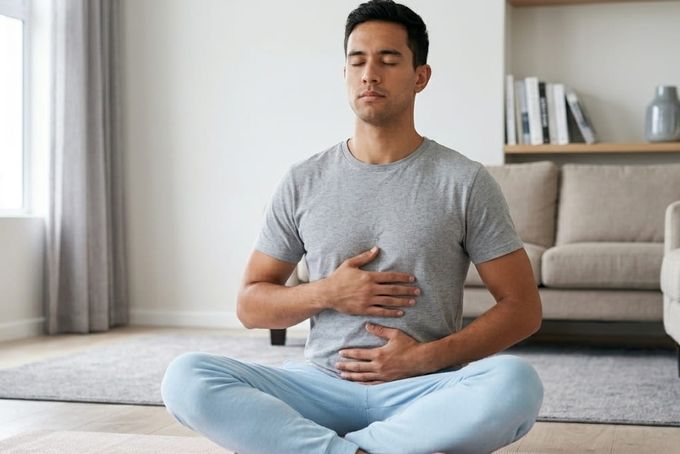
- Lie down or sit comfortably. Place one hand on your chest, one on your lower belly.
- Inhale slowly through your nose. Let your belly and lower ribs gently rise. Your chest hand should stay relatively still. Imagine the pelvic floor softening downward.
- Exhale slowly through your mouth. Let your belly soften without pushing the air out.
- Keep shoulders, jaw, inner thighs, and buttocks relaxed throughout. The breath should feel comfortable, not effortful.
Practice for 5 to 10 minutes once or twice daily. Shorter sessions of 3 to 5 minutes are fine to start. You can gradually increase these sessions later on.
Common Mistakes When Doing Diaphragmatic Breathing
- Forcing the belly outward: This increases abdominal pressure and pelvic floor tension rather than reducing them [4].
- Holding the breath: It causes muscle bracing and pelvic pressure. Keep breathing slowly and continuously [5].
- Bearing down: Trying to actively "drop" the pelvic floor can create straining rather than relaxation. Let it soften on its own.
- Chest breathing: If your shoulders are rising, bring your focus back to the lower ribs and belly.
- Breathing too deeply: Excessively large breaths may cause dizziness or increase your pelvic pressure. Smaller, gentler breaths often work better.
360 Breathing and the 90/90 Position
With regular diaphragmatic breathing, the breath mostly expands the front of the belly. 360 breathing takes this further by encouraging expansion in all directions, front, sides, and lower back, for a more balanced distribution of pressure throughout the trunk.
This can improve coordination across the whole core and pelvic floor, and it tends to be especially helpful for pelvic tension, constipation, and managing pressure during exercise [3, 6].
When to Seek Professional Support for Pelvic Health
Breathing practice alone is not enough if your symptoms are persistent or worsening. Seek professional care if:
- Pelvic pain, painful intercourse, or constipation has not improved after several weeks of consistent practice
- Breathing exercises consistently feel stressful or increase tension
- Symptoms are overlapping (for example, pelvic pain alongside bladder urgency and bowel changes)
Conditions like endometriosis or chronic pelvic pain syndrome often need individualized treatment beyond what breathing alone can address [7, 8].
How kGoal Can Help Support Pelvic Health
One of the real challenges with breathing-based pelvic floor work is that it's hard to know whether the pelvic floor is actually relaxing or just staying tense.
kGoal devices address this with real-time tactile and vibrational biofeedback, which lets you feel whether relaxation and activation are happening as intended, rather than guessing.
This can help with:
- Coordinating your breathing with pelvic floor relaxation
- Quantifying pelvic floor muscle function over time
- Supporting Down Training for hypertonic (overly tight) muscles
- Making practice more engaging and easier to maintain consistently
kGoal Boost for men and Boost for women are particularly suited for Down Training. kGoal Classic is an intravaginal option better suited for strengthening-focused training.

Support Your Pelvic Health the Right Way
With kGoal, you get real-time feedback that helps you master your breathing technique and relax your pelvic floor with confidence.
Mastering Diaphragmatic Breathing for Pelvic Health
Diaphragmatic breathing should feel easy, not effortful. Small, relaxed breaths are more effective than big, forced ones. With consistent practice over several weeks, many people notice real changes in tension, urgency, and comfort.
For more complex symptoms, combining breathing with pelvic floor physical therapy and biofeedback tools like kGoal Boost for men and women tends to produce the most meaningful results.

References
[1] Ma, X., et al. (2017). The effect of diaphragmatic breathing on attention, negative affect and stress in healthy adults. Frontiers in Psychology, 8, 874. https://doi.org/10.3389/fpsyg.2017.00874
[2] Zaccaro, A., et al. (2018). How breath-control can change your life: A systematic review on psycho-physiological correlates of slow breathing. Frontiers in Human Neuroscience, 12, 353. https://doi.org/10.3389/fnhum.2018.00353
[3] Bordoni, B., & Zanier, E. (2013). Anatomic connections of the diaphragm: Influence of respiration on the body system. Journal of Multidisciplinary Healthcare, 6, 281–291. https://doi.org/10.2147/JMDH.S45443
[4] Harvard Health Publishing. (2020). Relaxation techniques: Breath control helps quell errant stress response. https://www.health.harvard.edu/mind-and-mood/relaxation-techniques-breath-control-helps-quell-errant-stress-response
[5] Cleveland Clinic. (2022). Diaphragmatic breathing exercises and benefits. https://my.clevelandclinic.org/health/articles/9445-diaphragmatic-breathing
[6] Hodges, P. W., Sapsford, R., & Pengel, L. H. M. (2007). Postural and respiratory functions of the pelvic floor muscles. Neurourology and Urodynamics, 26(3), 362–371. https://doi.org/10.1002/nau.20232
[7] Mayo Clinic. (2023). Chronic pelvic pain in women. https://www.mayoclinic.org/diseases-conditions/chronic-pelvic-pain/symptoms-causes/syc-20354368
[8] Hopper, S. I., et al. (2019). Effectiveness of diaphragmatic breathing for reducing physiological and psychological stress in adults. JBI Database of Systematic Reviews and Implementation Reports, 17(9), 1855–1876. https://doi.org/10.11124/JBISRIR-2017-003848
FAQs
Does diaphragmatic breathing actually help the pelvic floor?
Yes, mainly for people dealing with pelvic tension, urgency, or overactive muscles. During breathing in, the pelvic floor naturally relaxes and lowers in response to the diaphragm moving downward. Consistent practice may reduce muscle guarding and improve symptoms over several weeks [3].
How long does it take to see results?
Some people notice relaxation after the first few sessions. Meaningful changes in muscle tension or symptoms usually develop over 2 to 6 weeks of regular practice. Consistency matters more than session length [5].
Can men benefit from diaphragmatic breathing for pelvic floor health?
Absolutely. The pelvic floor plays an important role in bladder control, bowel function, and sexual health in men as well as women. Breathing-based relaxation can help reduce pelvic tension and improve diaphragm and pelvic floor coordination for people of any gender [3].
What is the difference between 360 breathing and regular diaphragmatic breathing?
Regular diaphragmatic breathing encourages the belly and lower ribs to expand when you breathe in. 360 breathing extends this to include the sides of the ribcage and lower back, promoting more balanced pressure distribution throughout the trunk. It's especially useful for pelvic tension, pressure management during exercise, and constipation [3, 6].
What is the 90/90 breathing position?
It involves lying on your back with both hips and knees bent at 90 degrees, feet resting on a wall or chair. This position relaxes the lower back and makes it easier to feel the breath expand into the back and sides of the ribcage, which is helpful for people who struggle to release tension in the pelvic floor.
When should someone see a pelvic floor physical therapist instead of practicing on their own?
If your symptoms are severe, persistent, or getting worse despite regular practice, professional assessment is important. A PFPT can identify whether tension or weakness is the real issue and tailor treatment accordingly. They are also the right first step for anyone with complex or overlapping pelvic symptoms [7, 8].