kGoal vs. Elvie: Best Pelvic Floor Trainer for You
Both kGoal and Elvie are pelvic floor trainers that use biofeedback, but the way they deliver that feedback and who they work best for, is different. This post helps you figure out which pelvic floor trainer matches your situation, whether you're rebuilding strength, managing incontinence, or just starting out.


Published May 19, 2026

Both kGoal and Elvie are pelvic floor trainers with app-based biofeedback that give you real-time guidance, showing you what your muscles are doing. But they approach training differently, and that difference matters quite a lot when choosing a pelvic floor trainer.
This comparison breaks down exactly where kGoal and Elvie diverge and which one is likely the better fit for your goals, your body, and how you learn best.
How kGoal and Elvie Approach Pelvic Floor Training Differently
When it comes to these pelvic floor trainers, it's important to note that kGoal has trainers that can be used by both men and women, whereas Elvie is meant for female use only.
Aside from this, all of the trainers use sensors to detect pelvic floor activity and show it through a smartphone app. But what they measure and how they feed it back to you reflects different training philosophies:
kGoal vs. Elvie Key Differences
| kGoal | Elvie |
|---|---|---|
Feedback type | Tactile + visual | Visual only |
Insertable option | Yes | |
Non-insertable option | Yes (Boost for men and women) | No |
Down Training support | Yes (Boost) | No |
Tracks strength and endurance | Yes | Limited |
Available for men | Yes (Boost) | No |
Price | From ~$179 | ~$199 |
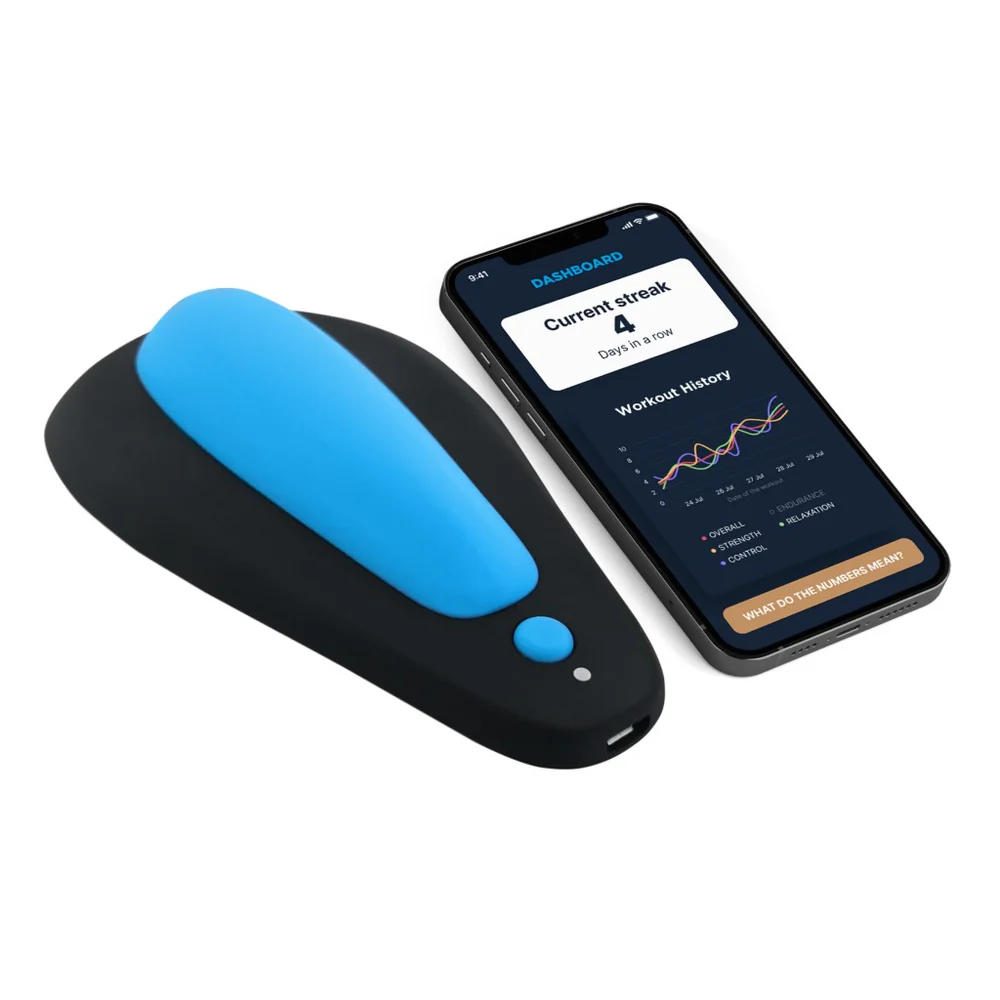
Non-Insertable Pelvic Floor Training (kGoal Boost)
kGoal Boost uses a sit-on-top design where you place the trainer on a seat and sit on it like a bike seat, leaving your clothes on. This approach is great for ease of use and also for users of any gender who prefer to avoid vaginal or rectal insertion. The avoidance of insertion also makes it a great tool to support pelvic floor muscle relaxation (Down Training) work, since it is common for people who need Down Training — typically caused by an overactive or "hypertonic" pelvic floor — to have discomfort with insertion.
kGoal Boost also provides tactile biofeedback, in addition to visual biofeedback through the app. This approach aligns well with how pelvic floor physical therapists do pelvic floor muscle function assessments in the clinic. The use of resistance-based force biofeedback makes it easier to translate what you feel during home training into something clinically meaningful [1].
Pros
- Works without insertion, for men and women.
- Tactile and visual biofeedback combined.
- Supports both strengthening and relaxation.
- Tracks real strength progress over time.
Cons
- Requires sitting during sessions.
- Requires user to avoid moving around during workouts (shifts in posture / position can change measurements, although it's possible to recalibrate on the fly to fix that when it happens).
Insertable Pelvic Floor Training (Elvie, kGoal Classic & IntimFlex)
Elvie and kGoal Classic / IntimFlex measure pelvic floor muscle activation using an intravaginal probe. Each of these trainers provides pressure-based visual biofeedback, converting pelvic floor activation into on-screen movements and guided sessions. However, the kGoal trainers also provide tactile biofeedback via the device, in addition to the visual biofeedback.
Insertable trainers are particularly good for supporting functional exercise and more flexibility in terms of usage, whether that is lying down, sitting, standing, or moving around (running errands, doing exercise classes, etc). To support this use case, kGoal trainers offer Background workout capability, where you can measure and track your pelvic floor activation even when you're not actively using the app.
Pros
- Sleek, compact design.
- Supports wide variety of usage scenarios and functional exercise.
- Structured, game-based sessions.
- Easy app-guided format.
Cons
- Visual feedback only (Elvie; kGoal trainers offer tactile biofeedback as well).
- Women only, insertion required.
- Not ideal for Down Training support.
What Biofeedback Actually Feels Like
What you feel like, using the device, is one area where the practical difference becomes clearest.
How Does it Feel to Use kGoal?
With kGoal trainers, the feedback is embodied. You feel the resistance and vibrational biofeedback, and the app shows your actual effort. That makes it easier to confirm when you're engaging the right muscles, especially if you're new to pelvic floor training or unsure whether you're doing Kegels correctly.
This matters because your pelvic floor is an internal muscle group. You can't see it, and many people struggle to feel it clearly.
Having feedback that you can sense directly, not just watch on a phone screen, helps the brain connect to the right muscles faster [3].
How Does it Feel to Use Elvie?
Elvie relies on visual feedback through the app. That works well for users who already have reasonable body awareness and are looking for structured, guided sessions to stay consistent. It's a gentler entry point for some people.
kGoal vs. Elvie: Which Pelvic Floor Trainer Fits Your Situation
Choose kGoal if you
- Value having the option for both tactile and visual biofeedback for pelvic floor training (the tactile biofeedback can be turned off on days you prefer visual only).
- Prefer a non-insertable option like the kGoal Boost (available for both men and women), which is a sit-on-top trainer that requires no insertion and still provides biofeedback.
- Need down training (relaxation exercises for a pelvic floor that is too tight or painful). Boost supports this in a way most pelvic floor trainers don't.
- Want to be able to track your exercise performance while doing functional fitness and not actively using your Kegel app.
- Are rebuilding pelvic floor strength after childbirth, prostate surgery, or a period of weakness.
Choose Elvie if you:
- Already have some body awareness and don't need tactile biofeedback.
- Prefer to use visual biofeedback only.
- Are comfortable with vaginal insertion and prefer a rigid, force-sensor based approach over an inflatable, pressure-sensor based approach.
Three Questions to Ask Yourself Before Choosing a Pelvic Floor Trainer
Do you know which muscles are in your pelvic floor? If not, research shows that feedback linking effort to physical sensation improves accuracy and confidence significantly more than visual feedback alone [4]. kGoal's tactile biofeedback approach is better suited here.
Are you trying to measure functional fitness work? kGoal Classic, kGoal IntimFlex, and Elvie are all wearable during functional exercise practice but only the kGoal trainers offer the ability to measure and track pelvic floor muscle activity in the background, even when you're not actively using the app (for instance, if you don't want to keep you phone in hand or are using a different app to follow along with an exercise class).
Do you prefer not to use an insertable device? Elvie requires vaginal insertion. kGoal Classic and IntimFlex are also insertable, but kGoal Boost is a sit-on-top external option for people who want easy-to-use biofeedback without insertion. It works for both men and women, which makes it the only validated external pelvic floor trainer with biofeedback currently available.
A Note on Consistency for Any Pelvic Floor Trainer
Whichever trainer you choose, consistency matters more than the device itself.
Most people begin noticing changes within 6–8 weeks of consistent training, with more significant improvements by 12–16 weeks. That timeline applies to both kGoal and Elvie users, provided the technique is correct from the start.
The Better Choice From kGoal vs. Elvie
Both are legitimate pelvic floor trainers. Elvie suits users who want app-guided structure and have some baseline body awareness. kGoal suits users who want measurable, resistance-anchored feedback, especially those rebuilding strength, starting from a low baseline of body awareness, or needing a non-insertable option.
For men, kGoal Boost is the clearest option. Elvie does not offer a men's version. For women with pelvic pain or tension, kGoal Boost's Down Training support addresses a gap that most pelvic floor trainers, including Elvie, don't cover.
If you're unsure where to start, speaking with a pelvic floor physical therapist before purchasing any device is always worthwhile. They can help you understand exactly what your pelvic floor needs and which trainer will actually support that.
Make the Right Choice
With kGoal showing you in real-time whether you're doing it right, perform exercises that actually work.
References
1. Fernandes, A. C. N., Jorge, C. H., Weatherall, M., Ribeiro, I. V., Wallace, S. A., & Hay-Smith, E. J. C. (2025). Pelvic floor muscle training with feedback or biofeedback for urinary incontinence in women. Cochrane Database of Systematic Reviews, 2025(3), CD009252. https://doi.org/10.1002/14651858.cd009252.pub2
2. Dar, G., & Saban, T. S. (2022). The Perception of Pelvic Floor Muscle Function amongst Exercising Women Who Are Repeatedly Instructed to Contract Their Pelvic Floor Muscles. Healthcare, 10(9), 1768. https://doi.org/10.3390/healthcare10091768
3. Biofeedback - Mayo Clinic. (n.d.). https://www.mayoclinic.org/tests-procedures/biofeedback/about/pac-20384664
4. Vojtko, M., Banovcin, P., Duricek, M., Hoferica, J., & Liptak, P. (2025). Home Biofeedback Training for Pelvic floor Disorders: Is there hope for hopeless patients? Gastrointestinal Disorders, 7(2), 35. https://doi.org/10.3390/gidisord7020035Vojtko, M., Banovcin, P., Duricek, M., Hoferica, J., & Liptak, P. (2025). Home Biofeedback Training for Pelvic floor Disorders: Is there hope for hopeless patients? Gastrointestinal Disorders, 7(2), 35. https://doi.org/10.3390/gidisord7020035
5. Marques, A., Stothers, L., & Macnab, A. (2010). The status of pelvic floor muscle training for women. Canadian Urological Association Journal, 4(6), 419–424. https://doi.org/10.5489/cuaj.10026
FAQs
Is kGoal better than Elvie?
It depends on your needs. kGoal provides resistance-based tactile and visual biofeedback, tracks strength progressively, and offers a non-insertable option (Boost) for both men and women. Elvie offers structured, app-guided sessions with visual feedback. If you need measurable strength training or a non-insertable option, kGoal is the stronger fit.
Can men use a pelvic floor trainer?
Yes — pelvic floor training is beneficial for men managing bladder control, recovering from prostate surgery, or improving sexual function. kGoal Boost is designed for both men and women. Elvie's trainer is for women only.
What is Down Training in pelvic floor therapy?
Down Training refers to relaxation exercises for a pelvic floor that is too tight or overactive [called hypertonic]. This is different from Kegel strengthening, and is relevant for people experiencing pelvic pain or tension. kGoal Boost supports Down Training; most other consumer pelvic floor trainers do not.
How long does it take to see results from a pelvic floor trainer?
Most people notice early changes within 6–8 weeks of consistent training. More significant improvements typically appear by 12–16 weeks. Results depend on correct technique, consistency, and whether the training approach matches your specific pelvic floor condition.
Do I need to see a pelvic floor physical therapist before using a pelvic floor trainer?
It is not strictly required, but it is strongly recommended — especially if you experience pain, have had recent surgery, or are unsure whether your muscles are weak or tight. A PFPT can assess your pelvic floor directly and help you choose the right type of training from the start.