Stress Incontinence: How to Stop Urine Leakage When Coughing
Leaking urine when you cough is more common than most people think, and it's treatable. This guide explains what causes it, who it affects (both men and women), and six clinically backed ways to stop it.




Published May 14, 2026

Leaking urine mid-cough is an issue that many people experience, both men and women. In fact, it happens to about 1 in 4 women [1], and men can experience it too, particularly after prostate surgery. It's called stress incontinence. It's not emotional stress, but physical stress on the bladder.
It's common, nothing to be embarrassed about, and most importantly, it's very treatable. This guide covers what's going on, what causes it, and the approaches that actually help.
Why Do You Pee When You Cough?
When you cough, there's a sudden burst of pressure inside your abdomen in the space that holds your bladder.
In most people, the pelvic floor muscles (the group of muscles that sit like a sling at the base of your pelvis) tighten automatically in that same moment, keeping the urethra (the tube urine flows through) firmly closed.
With stress incontinence, that automatic response is off. The muscles might be weak, too tight to move properly, or just slow to react. The pressure wins, briefly, and a small amount of urine escapes [1].
In someone without stress incontinence, the pelvic floor tightens without them even thinking about it. With stress incontinence, that response just doesn't keep up.
Is It Normal to Pee When You Cough?
It's very common, but it's not something you just have to live with. Most people wait about two years before mentioning it to a doctor, usually out of embarrassment. This should never be the case.
Stress incontinence is a well-understood condition, and the earlier you deal with it, the easier it tends to get fixed.
What Causes Stress Incontinence?
Usually, it's a mix of things rather than one single cause. The most common ones are:
- Childbirth: Pregnancy and vaginal delivery stretch and strain the pelvic floor significantly. The muscles and supporting tissue may take a long time to recover, and sometimes they need help getting there [3].
- Menopause: Estrogen keeps the urethral tissue firm and elastic. As it drops, that tissue can weaken during menopause, making leaks more likely [4].
- Chronic coughing: A persistent cough from asthma, smoking, or a long-term respiratory condition puts repeated pressure on the pelvic floor day after day. Over time, that wears things down. Research links chronic cough to worsening leakage in around 40% of cases [5].
- High-impact exercise: Running, jumping, and heavy lifting all increase abdominal pressure. For someone with a weakened pelvic floor or pelvic organ prolapse, this can trigger leaks [6].
- Excess weight: Extra body weight adds constant pressure on the bladder. Even losing 5–10% of body weight can reduce symptoms noticeably [7].
- Surgery or injury: Prostate health and the pelvic floor can be affected after surgery in men, or pelvic surgery in women. It can affect the nerves and structures that control the bladder [8].
A Few Causes People Often Miss
Tight and weak pelvic floor muscles
One thing that surprises a lot of people: your pelvic floor can also be too tight, not just too weak.
When muscles are overly tense (called a hypertonic pelvic floor), they can't respond properly under pressure either; they need to be able to both contract and release. This is one reason "just do more Kegels" doesn't always work, and for some people, can actually make things worse.
Breathing patterns matter too
If you habitually hold your breath or brace your core, that adds low-grade pressure to the pelvic floor over time. And chronic constipation, the repeated straining involved, creates the same kind of downward pressure as coughing.
How to Stop Urine Leakage When Coughing
1. See a Pelvic Floor Physical Therapist First
This is genuinely the most useful thing you can do for both men and women. A pelvic floor physical therapist (PFPT) doesn't just give you a Kegel routine. They assess your specific situation: whether your muscles are weak, too tight, poorly coordinated, or a combination. From there, they build a plan that actually fits you.
Sessions typically involve guided exercises, breathing work, and biofeedback therapy (sensors that show your muscle activity on a screen). Many people see real improvement within 6–12 weeks of working with a therapist.
2. Pelvic Floor Exercises (Kegels) Done Right
Kegel exercises strengthen the muscles that support the urethra. They work well, but only when done correctly, and about 30% of people do them wrong without knowing it [9]. The most common mistake is bearing down instead of lifting up, which can actually make things worse.
Most people notice improvement within 6–8 weeks of daily practice, with stronger results by around 12–16 weeks [9].
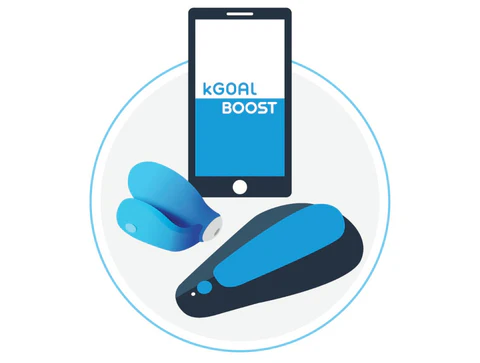
Do Kegels the Right Way
Use kGoal’s guided biofeedback to train accurately and get real results backed by research.
3. Biofeedback Training
Biofeedback takes the guesswork out of pelvic floor training. Sensors, either in a device or worn externally, measure your muscle activity and show it to you in real time, through an app or through vibration from the device itself.
Research shows that biofeedback-assisted training consistently outperforms unguided exercises [10]. It helps you confirm you're using the right muscles, catch mistakes before they become habits, track real progress over time, and, honestly, make training a lot less boring.
The best way to get at-home biofeedback training done
In a clinic, a PFPT provides biofeedback during sessions. At home, devices like kGoal let you do the same on your own schedule. kGoal stands out because it provides both visual feedback through the app and tactile vibration feedback, so you're getting real-time cues even when you're not watching the screen.
It also supports Down Training (pelvic floor relaxation), which is important if your muscles are too tight rather than too weak.
- kGoal Boost: A sit-on-top external trainer for women and a version for men, no insertion needed, works through clothing
4. The Knack Technique
The Knack is a simple trick that can help right away, even while you're waiting for longer-term training to kick in. Just before you cough, sneeze, or lift something heavy, give your pelvic floor a quick, deliberate squeeze. That pre-contraction closes off the urethra before the pressure spike arrives [11].
It takes a bit of practice to get the timing right. The key is squeezing before the cough, not during or after. And it should feel like a lift upward, not a push down. Once it becomes a habit, many people find it makes a noticeable difference fairly quickly.
5. Reduce the Pressure Load
Sometimes the most helpful thing isn't more exercises, it's removing unnecessary strain from your pelvic floor. A few practical changes include:
- Get a chronic cough treated; every cough is a pressure hit. If something like asthma, allergies, or a medication side effect is driving it, treating that directly makes a real difference.
- Manage constipation; straining creates the same downward pressure as coughing. Keeping bowel movements regular takes that load off.
- Exhale when you exert yourself; breathing out when you lift, stand up, or push reduces how much pressure transfers to the bladder.
- Manage weight if relevant; modest weight loss can meaningfully reduce constant bladder pressure.
6. Medical Devices and Surgery (When You Need Them)
Treating stress incontinence in women
A pessary (a small support device fitted internally by a clinician) can provide immediate physical support to the bladder neck. Around 76% of women report improvement after fitting [12].
It's a practical option, especially while building strength through exercises. For more severe cases, surgical options like the midurethral sling (a small mesh support placed under the urethra) have strong long-term success rates [13]. Surgery is always a last resort, but it's a good one when it's needed.
Treating stress incontinence in men
When pelvic floor training hasn't fully resolved symptoms, most commonly after prostate surgery, options include:
Urethral bulking injections (a minimally invasive procedure that adds bulk around the urethra to improve closure)
Or a male urethral sling, which works similarly to the female version by providing support under the urethra
For more severe cases, an artificial urinary sphincter (a surgically implanted device that mimics the role of the sphincter muscle) is considered the gold standard treatment [14]. As with women, these are reserved for cases where conservative approaches haven't been enough.
Why You Should Treat Stress Incontinence
Treating stress incontinence does more than just stop leaks. People consistently report feeling more confident in social situations, more comfortable exercising, and, for both men and women, improvements in sexual function as pelvic floor strength builds.
The mental load of constantly planning around potential leaks lifts too, which is something most people underestimate until it's gone.
Dealing With Stress Incontinence in the Meantime
If this has been affecting your daily life, avoiding the gym, wearing pads, and not laughing too hard, know that you're far from alone, and there's nothing to be ashamed of. It's a medical condition, not a character flaw.
While you're working on longer-term solutions, absorbent liners can help with peace of mind, cutting back on caffeine reduces bladder irritation, and using scheduled bathroom trips (rather than waiting for urgency) keeps your bladder from getting too full. These aren't fixes, but they help you stay in control of your day while the real work happens.
Living Leak Free Without Stress Incontinence
You don't have to just manage stress incontinence; you can actually fix it. Start with a pelvic floor physical therapist if you can access one. Use biofeedback to make sure your exercises are working. Try the Knack for immediate relief. And don't wait another two years to do something about it.
Stop Leaks When You Cough
With kGoal showing you in real-time whether you're doing it right, you do Kegels that actually work.

References
1. Milsom, I., Coyne, K. S., Nicholson, S., Kvasz, M., Chen, C., & Wein, A. J. (2013). Global Prevalence and Economic Burden of Urgency Urinary Incontinence: A Systematic review. European Urology, 65(1), 79–95. https://doi.org/10.1016/j.eururo.2013.08.031
2. Pang, D., Gao, Y., & Liao, L. (2022). Functional brain imaging and central control of the bladder in health and disease. Frontiers in Physiology, 13, 914963. https://doi.org/10.3389/fphys.2022.91496
3. Healthdirect Australia. (n.d.). Bladder weakness (incontinence) after birth. Pregnancy Birth and Baby. https://www.pregnancybirthbaby.org.au/bladder-weakness-after-birth
4. Menopause and urine incontinence - The Menopause Charity. (2025, May 26). The Menopause Charity. https://themenopausecharity.org/information-and-support/symptoms/menopause-and-urine-incontinence/
5. Stress incontinence. (2025, December 3). Cleveland Clinic. https://my.clevelandclinic.org/health/diseases/22262-stress-incontinence
6. Khowailed, I. A., Pinjuv-Turney, J., Lu, C., & Lee, H. (2020). Stress Incontinence during Different High-Impact Exercises in Women: A Pilot Survey. International Journal of Environmental Research and Public Health, 17(22), 8372. https://doi.org/10.3390/ijerph17228372
7. Wing, R. R., Creasman, J. M., West, D. S., Richter, H. E., Myers, D., Burgio, K. L., Franklin, F., Gorin, A. A., Vittinghoff, E., Macer, J., Kusek, J. W., & Subak, L. L. (2010). Improving urinary incontinence in overweight and obese women through modest weight loss. Obstetrics and Gynecology, 116(2), 284–292. https://doi.org/10.1097/aog.0b013e3181e8fb60
8. Professional, C. C. M. (2025, December 3). Incontinence after prostate surgery. Cleveland Clinic. https://my.clevelandclinic.org/health/symptoms/incontinence-after-prostate-surgery
9. Thiesse, R. (2023, March 14). Pelvic floor issues aren’t just a woman’s health condition, Kegels can work for men, too. Mayo Clinic News Network. https://newsnetwork.mayoclinic.org/discussion/pelvic-floor-issues-arent-just-a-womans-health-condition-kegels-can-work-for-men-too/
10. Cross, D., Waheed, N., Krake, M., & Gahreman, D. (2022). Effectiveness of supervised Kegel exercises using bio-feedback versus unsupervised Kegel exercises on stress urinary incontinence: a quasi-experimental study. International Urogynecology Journal, 34(4), 913–920. https://doi.org/10.1007/s00192-022-05281-8
11. Doing the knack to stop bladder leaks. (2023, June 6). UroToday. https://www.urotoday.com/center-of-excellence/functional-urology/144977-doing-the-knack-to-stop-bladder-leaks.html
12. Bugge, C., Adams, E. J., Gopinath, D., Stewart, F., Dembinsky, M., Sobiesuo, P., & Kearney, R. (2020). Pessaries (mechanical devices) for managing pelvic organ prolapse in women. Cochrane Database of Systematic Reviews, 2021(3), CD004010. https://doi.org/10.1002/14651858.cd004010.pub4
13. Dejene, S. Z., Funk, M. J., Pate, V., & Wu, J. M. (2021). Long-Term outcomes after midurethral mesh sling surgery for stress urinary incontinence. Female Pelvic Medicine & Reconstructive Surgery, 28(4), 188–193. https://doi.org/10.1097/spv.0000000000001094
14. Kim, J. C., & Cho, K. J. (2012). Current trends in the management of Post-Prostatectomy incontinence. Korean Journal of Urology, 53(8), 511. https://doi.org/10.4111/kju.2012.53.8.511
FAQs
Why do I pee when I cough?
Coughing creates a sudden spike of pressure inside your abdomen. If your pelvic floor muscles are weak or not coordinating properly, that pressure briefly overcomes your urethral closure, and a small amount of urine leaks out. This is called stress incontinence, and it's a well-understood and treatable condition.
Is it normal to pee when you cough?
It's common, affecting roughly 1 in 4 women and a significant number of men after prostate surgery. But "common" doesn't mean you have to live with it. It's very treatable, especially when addressed early.
How long does it take for pelvic floor exercises to work for stress incontinence?
Most people notice some improvement within 6–8 weeks of consistent daily practice, with stronger results by 12–16 weeks. The key factors are correct technique (biofeedback helps with this) and consistency. Results vary based on symptom severity and individual factors.
Can men get stress incontinence from coughing?
Yes. While it's more common in women, men can develop stress incontinence — particularly after prostate surgery, which can affect the muscles and nerves that support the urethra. The same approaches (pelvic floor training, biofeedback, the Knack technique) apply to men.
When should I see a doctor about leaking when I cough?
See a healthcare provider if leakage is affecting your daily life, if you've tried exercises for 8–12 weeks without improvement, if you experience pain during exercises, or if symptoms are getting worse. A pelvic floor physical therapist is an excellent first point of contact.