kGoal vs. Perifit: Choosing the Best Kegel Exerciser
kGoal and Perifit both offer biofeedback Kegel exercisers with app support, but they train your pelvic floor in meaningfully different ways. This post breaks down what sets them apart and helps you find the right fit for your situation.




Published May 19, 2026

If you have been comparing Kegel exercisers online, you have probably noticed that kGoal and Perifit come up a lot. Both connect to an app, both use biofeedback to provide real-time guidance showing you what your muscles are doing, and both claim to make pelvic floor training more effective. So what actually separates them?
The key elements of the answer come down to how each device teaches your muscles, not just how it tracks them, and how you use the products.
How kGoal and Perifit Approach Kegel Training Differently
These Kegel exercisers are built around different ideas of what good pelvic floor training actually looks like. One prioritizes what you feel. The other prioritizes what you see and do on screen.
Let's look into the key differences in more detail:
kGoal vs. Perifit: Key Differences
| kGoal | Perifit |
|---|---|---|
Feedback type | Tactile + visual | Visual only |
Insertable option | Yes | |
Non-insertable option | Yes (Boost for men and Boost for women) | No |
Down Training support | Yes (Boost) | No |
Tracks strength and endurance | Yes | Limited |
Available for men | Yes (Boost) | No |
Gamified sessions | Yes | Yes (primary focus) |
Price | From ~$179 | ~$149 to $179 |
Non-Insertable Pelvic Floor Training (kGoal Boost)
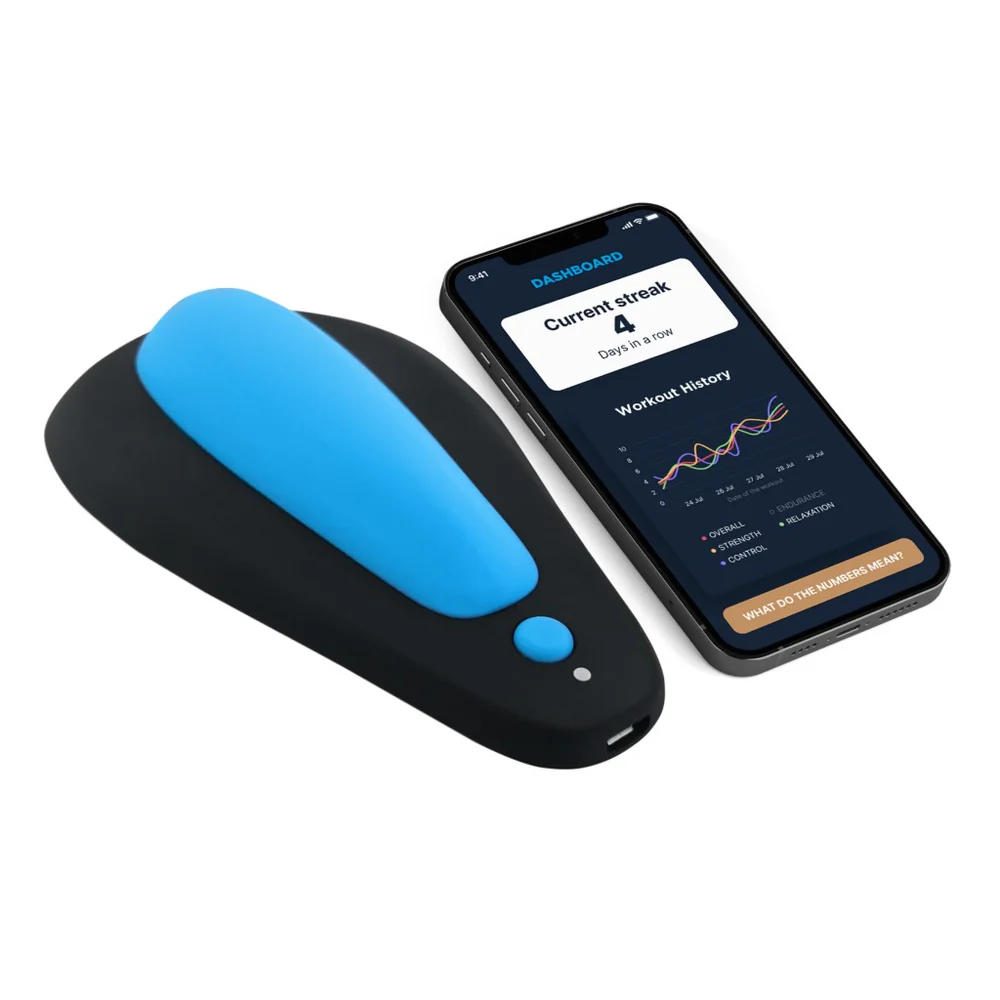
kGoal Boost uses a sit-on-top design where you place the trainer on a seat and sit on it like a bike seat, leaving your clothes on. This approach is great for ease of use and also for users of any gender who prefer to avoid vaginal or rectal insertion. The avoidance of insertion also makes it a great tool to support pelvic floor muscle relaxation (Down Training) work, since it is common for people who need Down Training — typically caused by an overactive or "hypertonic" pelvic floor — to have discomfort with insertion.
Furthermore, all kGoal trainers are built around the idea that you need to feel your pelvic floor working, not just watch a bar move on a screen. The trainers all provide tactile biofeedback that you can feel, in addition to visual biofeedback that you can see. This matters because your pelvic floor is an internal muscle group. You can't see it, and many people struggle to feel it clearly.
Having feedback that you can sense directly, not just watch on a phone screen, helps the brain connect to the right muscles faster.
Pros
- Works without insertion, for men and women.
- Tactile and visual biofeedback combined.
- Supports both strengthening and relaxation.
- Tracks real strength progress over time.
Cons
- Requires sitting during sessions.
- Requires user to avoid moving around during workouts (shifts in posture / position can change measurements, although it's possible to recalibrate on the fly to fix that when it happens).
Insertable Kegel Training (Perifit, kGoal Classic & kGoal IntimFlex)
Insertable pelvic floor trainers such as Perifit or kGoal Classic / IntimFlex take a different route. They measure pelvic floor muscle activation from within the vagina and provide force-based visual biofeedback that converts pelvic floor activation into on-screen movements. However, the kGoal trainers additionally provide tactile biofeedback via the device, in addition to the visual biofeedback.
Although kGoal provides gamified workouts in the app as well, Perifit is particularly game-oriented. Your squeezes control characters and games in the app, which makes sessions feel more like play than exercise.
Insertable trainers are particularly good for supporting functional exercise and more flexibility in terms of usage, whether that is lying down, sitting, standing, or moving around (running errands, doing exercise classes, etc). To support this use case, kGoal trainers offer Background workout capability, where you can measure and track your pelvic floor activation even when you're not actively using the app.
Pros
- Sleek, compact design.
- Structured, game-based sessions.
- Easy app guided format.
Cons
- Visual feedback only (Perifit; kGoal trainers offer tactile biofeedback as well).
- Women only, insertion required.
What Biofeedback Feels Like
Here is something worth knowing before you choose: up to 30 to 50% of people contract the wrong muscles entirely when they try to do Kegels without guidance. That is not a small number. It means a lot of people are working hard and getting very little back from it. [2].
Training With kGoal
The experience of using kGoal is grounded in physical sensation. You feel the resistance, the device responds to your effort, and the app shows you what that effort looks like over time. For people who have never been able to locate their pelvic floor reliably, this combination of feeling and seeing is often the thing that finally makes it click.
Because the vibration feedback happens in the device itself, you do not need to be watching your phone for the training to work. That matters more than it sounds, especially for people who find it hard to focus on a screen and a muscle contraction at the same time.
How Does It Feel to Use Perifit?
Perifit's gamified exercises feel more like playing a game than doing physical therapy, which is genuinely appealing if you find traditional exercise routines hard to stick to. The gamified format keeps sessions short and engaging, and for people who already have reasonable body awareness, the on-screen feedback is clear and satisfying.
The limitation is that visual feedback can be less embodied for many people than tactile feedback (or visual + tactile feedback).
kGoal vs. Perifit: Which Kegel Exerciser Fits Your Situation
Choose kGoal if you:
- Value having the option for both tactile and visual biofeedback for pelvic floor training (the tactile biofeedback can be turned off on days you prefer visual only).
- Are rebuilding pelvic floor strength due to menopause after childbirth, prostate surgery, or a period of weakness.
- Prefer not to use an insertable device (kGoal Boost is a sit-on-top tool and works for both men and women with no insertion needed).
- Have been told your pelvic floor is tight or overactive and needs down training rather than strengthening.
- Want to be able to track your exercise performance while doing functional fitness and not actively using your Kegel app.
Choose Perifit if you:
- Have already fully identified your pelvic floor muscles and don't need tactile biofeedback.
- Strongly value game-based motivation for sticking to a routine.
- Are comfortable with vaginal insertion and prefer a rigid, force-sensor based approach over an inflatable, pressure-sensor based approach.
What to Ask Yourself Before Choosing a Kegel Exerciser
Can you actually feel your pelvic floor contracting? If the honest answer is no, a device that gives you physical sensation alongside visual feedback will serve you far better early on. Research consistently shows that combining what you feel with what you see accelerates correct muscle learning [4].
Is functional fitness practice a priority for you? You can wear any of kGoal Classic, kGoal IntimFlex, and Perifit while doing functional exercise like walking, climbing stairs, doing squats / lunges, running errands, or even doing exercise classes like yoga or Pilates. However, only kGoal trainers enable you to quantify and evaluate your muscle function and functional exercise performance while you're not actively using the app (and watch your progress over time).
Does insertion feel like a barrier? Both devices have insertable options. But if insertion is something you would rather avoid, only one of them offers a validated alternative with full biofeedback. kGoal Boost is the only external sit-on-top Kegel exerciser of its kind currently available, and it works for men as well as women.
Making the Most of Any Kegel Exerciser
No device works without you. Adherence, meaning showing up consistently and training with correct technique, predicts outcomes more reliably than which product you choose. A device that makes training feel clear and rewarding is one you are more likely to keep using, which is ultimately what determines whether you see results.
Most people notice something shifting within 8 to 12 weeks. Meaningful, lasting improvement tends to come closer to 12 to 16 weeks of regular practice.
More sessions do not mean faster progress. Getting the technique right from the beginning matters far more than intensity.
The Right Choice From kGoal vs. Perifit
Perifit is a good fit for women who are already somewhat body aware and want an engaging, game-based routine to build on. kGoal is a better fit for anyone who needs clearer confirmation of correct muscle identification, wants to track measurable strength gains via functional exercise, or needs a device that works without insertion.
For men specifically, kGoal Boost is the only option here. Perifit does not have a men's version. For anyone dealing with pelvic pain or tension, Down Training support is not a nice-to-have; it is essential, and kGoal Boost is one of the few consumer devices that provides it.
If you're in doubt, start with a pelvic floor physical therapist. Knowing what your pelvic floor actually needs before you invest in a device makes every session after that more effective.
Do Kegels the Right Way
With kGoal showing you in real-time whether you're doing it right, you do Kegels that actually work.
References
1. Horng, H., Chao, W., Chen, J., Chang, C., Wang, P., & Chang, P. (2021). Home-based noninvasive pelvic floor muscle training device to assist women in performing Kegel exercise in the management of stress urinary incontinence. Journal of the Chinese Medical Association, 85(4), 484–490. https://doi.org/10.1097/jcma.0000000000000660
2. Common_errors_made_in_attempt_to_contract_the_pelvic_floor_muscles_in_women_early_after_delivery_A_prospective_observational_study https://www.researchgate.net/publication/321218289
3. Burgio, K. L., Robinson, J., & Engel, B. T. (1986). The role of biofeedback in Kegel exercise training for stress urinary incontinence. American Journal of Obstetrics and Gynecology, 154(1), 58–64. https://doi.org/10.1016/0002-9378(86)90393-5
4. Cross, D., Waheed, N., Krake, M., & Gahreman, D. (2022). Effectiveness of supervised Kegel exercises using bio-feedback versus unsupervised Kegel exercises on stress urinary incontinence: a quasi-experimental study. International Urogynecology Journal, 34(4), 913–920. https://doi.org/10.1007/s00192-022-05281-8
5. Marques, A., Stothers, L., & Macnab, A. (2010). The status of pelvic floor muscle training for women. Canadian Urological Association Journal, 4(6), 419–424. https://doi.org/10.5489/cuaj.10026
FAQs
Is kGoal better than Perifit?
It depends on what you need. kGoal provides both tactile and visual biofeedback, tracks strength and endurance progressively, and offers a non-insertable option for men and women. Perifit focuses on gamified, coordination based sessions with visual feedback. If you need measurable strength training, a non-insertable option, or Down Training support, kGoal is the stronger fit.
Can men use a Kegel exerciser?
Yes. Pelvic floor training benefits men managing bladder control, recovering from prostate surgery, or improving sexual function. kGoal Boost is designed for both men and women. Perifit is for women only.
What is Down Training and why does it matter?
Down Training refers to relaxation exercises for a pelvic floor that is overactive or too tight. This is the opposite of Kegel strengthening and is relevant for people experiencing pelvic pain or tension. kGoal Boost supports Down Training; most consumer Kegel exercisers including Perifit do not.
How long before you see results from a Kegel exerciser?
Most people notice early changes within 8 to 12 weeks of consistent training. Results depend on correct technique, consistency, and whether the training approach matches your specific pelvic floor condition.
Do I need a pelvic floor physical therapist if I use a Kegel exerciser at home?
Not strictly required, but strongly recommended, especially if you have pain, recent surgery, or are unsure whether your muscles need strengthening or relaxation. A pelvic floor physical therapist can assess your pelvic floor directly and make sure your training is working in the right direction from the start.