6 Proven Sexual Benefits of Kegel Exercises for Men: Full Control
Kegel exercises for men can genuinely improve certain parts of sexual function. Here's what six of those benefits look like in practice, backed by research, along with proper Kegel technique and its limits.




Updated September 30, 2026

Kegel exercises can benefit males sexually in ways backed by real research, not just internet hype. Strengthening the pelvic floor can lead to firmer erections, better control over ejaculation, and faster recovery after prostate surgery – benefits that hold up in clinical studies, not just anecdotes. Men with erectile dysfunction or premature ejaculation, the two conditions where Kegels show the clearest results, tend to see the biggest gains.
You may have also seen bigger claims floating around, like Kegels boosting testosterone or size, but those don't hold up as well. This guide walks through six proven benefits, what a realistic result looks like for each, the correct technique, and where Kegels reach their limit.
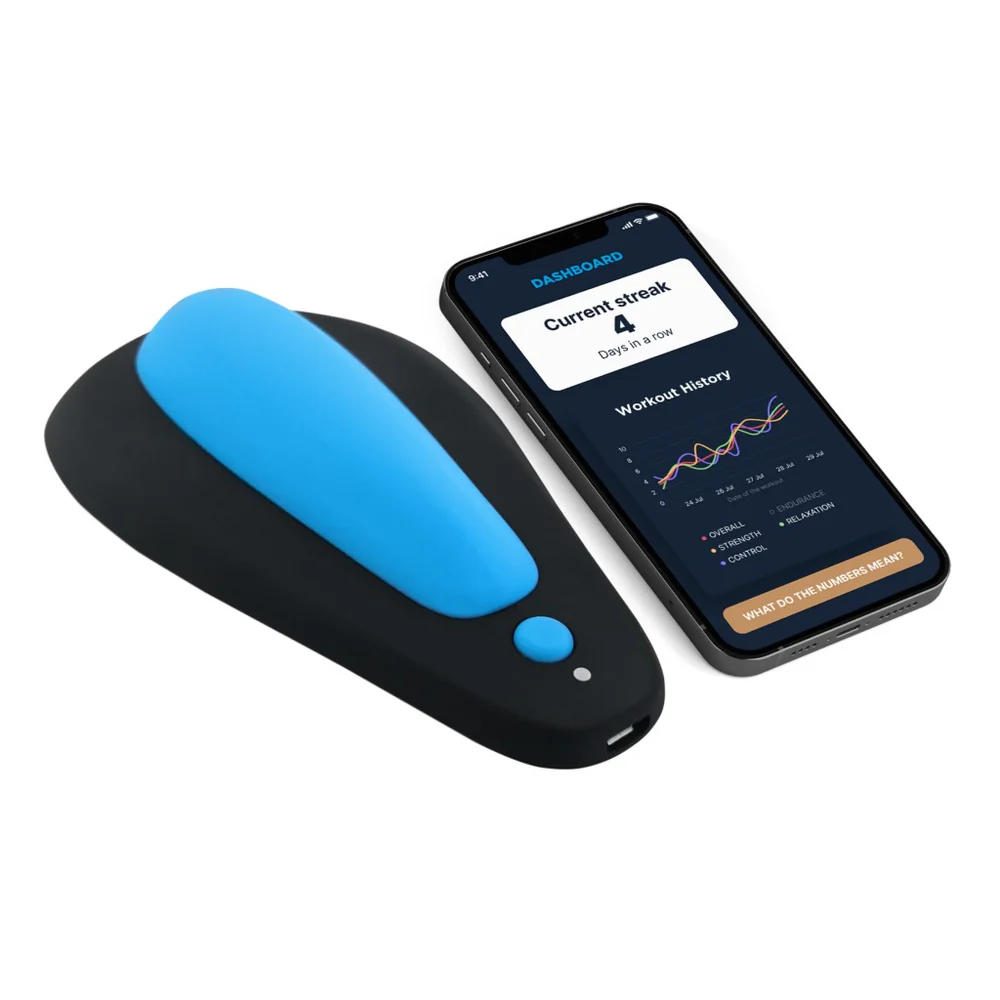
Ensure Your Kegels Really Count
kGoal Boost for men gives real-time feedback, so you know you're doing them right.
What Kegel Exercises for Men Actually Are
Kegel exercises, also called pelvic floor exercises for men, are a targeted strengthening move. They involve squeezing and releasing the muscles at the base of your pelvis using roughly the same motion as stopping your urine stream mid-flow.
Which Muscles Are Involved?
The pelvic muscles that matter most for sex are the bulbospongiosus and the ischiocavernosus, which wrap around the base of the penis. The ischiocavernosus helps keep blood inside the penis during an erection, and the bulbospongiosus contracts to help push semen out during ejaculation [1].
A Kegel does a different job than that of a plank or a set of crunches. This is because these two types of exercises target different muscle groups, as shown below.
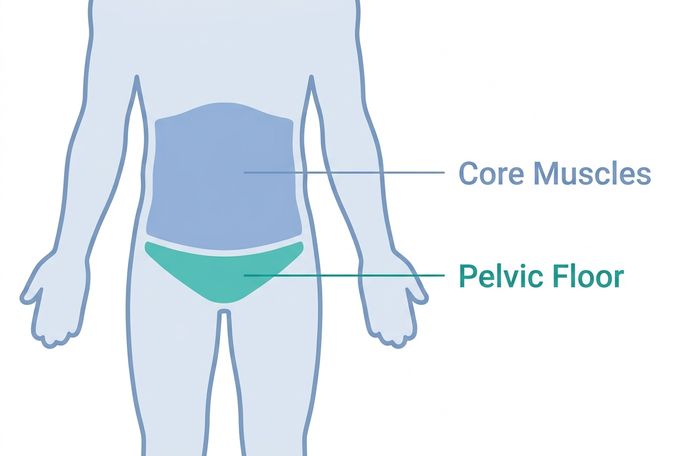
Abdominal training works your abs and trunk, which helps with posture and stability, but it doesn't specifically train the pelvic floor. A strong core doesn't necessarily mean a strong pelvic floor.
Here's an overview of how the two compare:
| Core Training | Pelvic Floor Training |
|---|---|---|
Main muscles | Abs, obliques, lower back | Bulbospongiosus, ischiocavernosus |
What it supports | Trunk stability, posture | Erection rigidity, ejaculation timing, bladder control |
Where they overlap | Both engage during heavy lifting or bracing | Both engage during heavy lifting or bracing |
6 Ways Kegel Exercises Benefit Men Sexually
Kegels don't have the same effect on all men, and the level of improvement isn't universal. Let's look at the main realistic gains you can expect from Kegel exercises and the research to back each one up.
1. Firmer Erections
Your pelvic floor muscles help trap blood inside the penis once you're erect. When the ischiocavernosus and bulbospongiosus contract, they raise pressure at the base of the penis, which is part of what keeps an erection firm instead of half-hard [1].
That's a modest bump, but still noticeable. In practice, this usually shows up as a firmer baseline erection, not a total transformation. You'll notice it most if a weak or uncoordinated pelvic floor was part of why your erections felt softer than you wanted.
If your erectile function was already normal, don't expect Kegels to push it further. They support the mechanics of an erection, but they can't fix low blood flow or low testosterone on their own.
2. Better Erection Maintenance
Getting firm is one thing, but staying firm during sex is another. It often comes down to how well your penis holds onto blood instead of losing it too fast, something doctors call venous leakage, where blood drains out faster than it should. Your pelvic floor muscles help by squeezing the veins that let blood escape.
You're most likely to notice this benefit if your problem isn't getting hard, but staying hard, and if leakage is part of your diagnosis rather than a hormonal or psychological cause.
3. Improved Overall Erectile Function
Pelvic floor training doesn't just target one part of an erection. It seems to improve how well the muscles involved in getting and keeping an erection work together, especially with biofeedback therapy (real-time feedback showing which muscles you're using) [4].
About a quarter of the men in that trial didn't notice an improvement, so this isn't a guarantee. Still, if your erectile dysfunction is connected to the pelvic floor, these numbers show genuine improvement is possible with consistent, correct practice.
4. Better Ejaculation Control
Ejaculation is a muscular event. Your bulbospongiosus contracts rhythmically to push semen out. Learning to control that muscle on purpose, instead of letting it fire automatically, seems to help some men delay ejaculation and sense it coming sooner [5].
Those are meaningful gains, especially if you're starting under a minute. That said, this evidence is a bit thinner than what we have for erectile dysfunction. It's promising, not settled, and results vary more from person to person here.
5. Improved Orgasmic Function
The muscles that contract during ejaculation are active during orgasm too, so researchers have also looked at whether training them changes orgasm quality, not just timing.
That's a marked difference, but it's from a smaller study. Think of it as a possible bonus of training muscles already involved in the process, rather than your main reason to start.
If orgasm intensity is your top priority, the evidence here is weaker than for the other benefits on this list, so keep your expectations realistic.
6. Better Sexual Function After Prostate Surgery
Radical prostatectomy, surgery to remove the prostate, often affects erectile function afterward, sometimes for months. Pelvic floor rehab is one tool shown to help men recover more of that function, especially when it starts early with proper guidance [7].
That's a big difference for a group whose recovery often feels slow. This benefit is specific to men recovering from prostate surgery, not a general finding.
If that's you, ask your surgical team about starting pelvic floor exercises as soon as you're cleared. These tips for pre- and post-surgery recovery can also help.
How to Do Kegels Correctly for Sexual Benefit
Getting these benefits starts with doing the exercise correctly, not with doing more of it. Here's the technique, step by step:
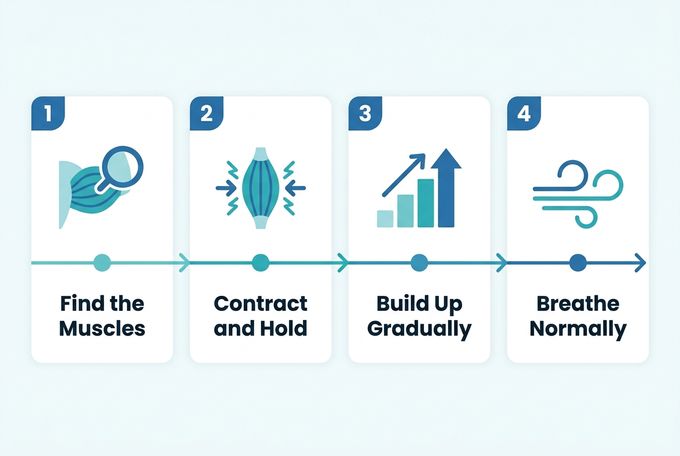
- Find the muscles: Tighten as if you're stopping urine and holding in gas at the same time. But only use this method of stopping urine to find them, not as a regular exercise, since doing this often can interfere with bladder emptying [8].
- Contract and hold: Start lying down, squeeze upward and inward, hold for 3 seconds, then relax fully for 3 seconds.
- Build up gradually: Work toward 10 to 15 contractions per set, 3 sets a day, then try the same movement sitting and standing.
- Breathe normally: Avoid squeezing your abs, thighs, or glutes while you do it.
Signs You're Engaging the Right Muscles
The Kegels should feel like a gentle inward lift, not a full-body squeeze. Research shows that men who keep the bigger muscles relaxed see the most noticeable gains [9].
Here's how to tell whether it's working, or whether other muscles have taken over:
- Right muscles: The penis pulls in slightly, the testicles lift a little, and you feel a faint lift in the perineum, the area between the scrotum and anus.
- Wrong muscles: Your abs brace, your glutes clench, or you catch yourself holding your breath.
Bracing is the single most common mistake that cancels out the benefit. It turns the exercise into a general squeeze instead of training the muscles that support erections and ejaculation control.
If you have any doubts, a biofeedback device like kGoal Boost or a session with a pelvic floor physical therapist can confirm you're using the right muscles before a bad habit sets in.
Building a Kegel Routine That Works
The best Kegel exercises for men involve more than just using the right technique. Building the optimal Kegel training routine is just as important.
These are the key considerations to factor in:
How Long a Session Should Last
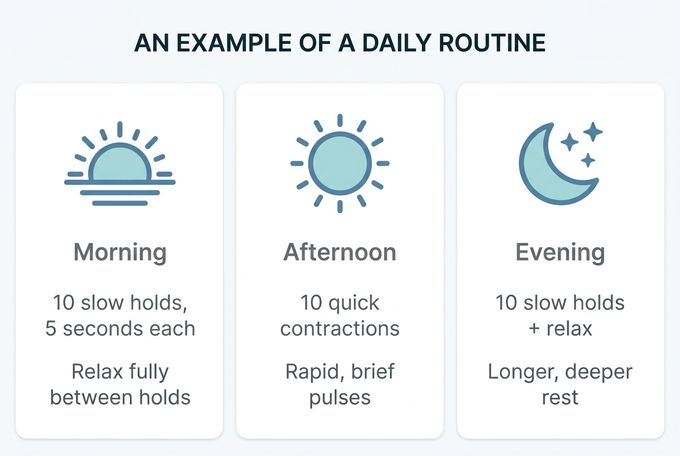
One set takes about a minute or two, and 3 sets a day beats one long session.
As you get stronger, you can hold longer. But more isn't always better. Tired muscles produce sloppy contractions, and a sloppy contraction doesn't train anything.
Best Time to Practice, and When to Skip It
There's no proven best time of day. Consistency matters more than timing.
A quick set before sex won't hurt, but don't tire the muscles out right beforehand. Kegels feel more comfortable after you've urinated, but don't make a habit of doing them while you pee, since it can interfere with normal bladder emptying [11].
How Long Does It Take to Notice a Difference?
Give it 8 to 12 weeks before deciding whether your Kegel routine is working [4].
- For premature ejaculation, a 12-week program helped 57% of 19 men gain better control [9].
- Erectile function scores improve significantly by three months in most trials, with more gains by six [4].
- Orgasm-related benefits take longer to show up, so there's no solid timeline yet [4].
If nothing's changed by 12 weeks, pelvic floor weakness probably isn't your main issue. Consider speaking to a healthcare practitioner for further advice.
Common Myths About the Benefits of Kegel Exercises for Men
Even solid research gets distorted once it hits social media. Here's where the biggest myths break down:
Myth 1: More Reps and Harder Squeezing Is Always Better
Your pelvic floor needs to relax fully between contractions, not stay tight all the time. A review of 10 studies found wide variation in routines, with no single best protocol [5].
An overactive, constantly tight pelvic floor has actually been linked to ED, premature ejaculation, and painful ejaculation, so squeezing harder can work against you [12].
Myth 2: Kegels Alone Are the Best Treatment for Premature Ejaculation
They can help, but they're not always the strongest option on their own. A 2026 review found pelvic floor training alone worked less well than medication or combined treatment, a difference of about 54 seconds in ejaculation latency [13]. Kegels are a solid piece of a bigger plan, but not necessarily the whole plan.
Myth 3: Kegels Cure Any Erectile Dysfunction
Kegels help when a weak pelvic floor is part of the problem, but ED has plenty of other causes, including:
- Blood flow issues
- Low testosterone
- Nerve damage
- Certain medications
- Stress
- Anxiety
In one trial, 40% of men regained normal function and 34.5% improved, but 25.5% saw no change [4]. So while it's useful, it's not a cure for every type of ED.
Myth 4: Results Show Up Within Days
Pelvic floor training works more like physical therapy than a quick fix. In the same trial, real improvement only showed up after three months, with more by six [4].
Expecting stronger erections after a few sessions will only leave you disappointed. Give it the same patience you'd give any strength program.
Myth 5: Kegels Enlarge the Penis, Boost Testosterone, and Increase Libido
There's no good evidence for any of this. A meta-analysis highlighted the benefits of pelvic floor training for ED and premature ejaculation, not penis size, testosterone, or libido [5].
The real way Kegel exercises benefit males sexually is through better muscle support and control, not a hormonal or anatomical upgrade.
When Kegels Aren't Safe, or Aren't Enough
Kegels aren't right for everyone, and they don't fix everything. Here's where to be careful, and when to get more help.
Can You Overdo Kegels?
Yes. Too many, or too forceful, without fully relaxing in between, can lead to an overactive pelvic floor, bringing on pelvic pain, urinary trouble, or painful ejaculation [12]. New pain or worsening symptoms mean stop and get assessed, not do more.
Who Should Be Cautious
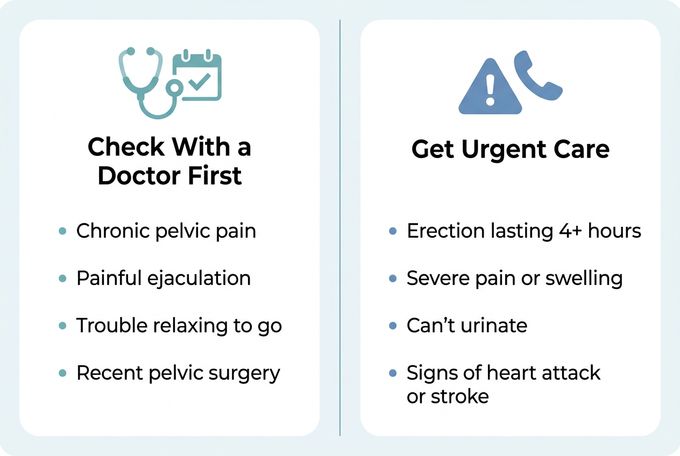
Check with a doctor if you have:
- Painful ejaculation
- Trouble relaxing to urinate or pass a bowel movement
- A urinary catheter in place
- Recent pelvic surgery without medical clearance
- Chronic pelvic or perineal pain
These symptoms often point to an overactive, or hypertonic, pelvic floor, which needs relaxation-focused therapy instead of more squeezing [14]. Research on men with chronic pelvic pain found that 51% had pelvic tenderness on exam, versus 7% of men without the condition [15].
What Kegels Won't Fix, and When to See a Doctor
Kegels strengthen muscles, but they won't fix vascular disease, diabetes, low testosterone, nerve problems, or several other causes of ED and premature ejaculation [16][17].
See a doctor if symptoms are persistent, worsening, sudden, or come with low libido, urinary symptoms, or heart risk factors, since ED can be an early sign of heart disease.
Get urgent care for:
- An erection lasting four hours or more
- Severe genital pain or swelling
- Inability to urinate
- Any signs of a heart attack or stroke [18]
How Biofeedback Can Support Your Routine
Biofeedback devices measure your pelvic floor contractions in real time, confirming you're using the right muscles instead of guessing.
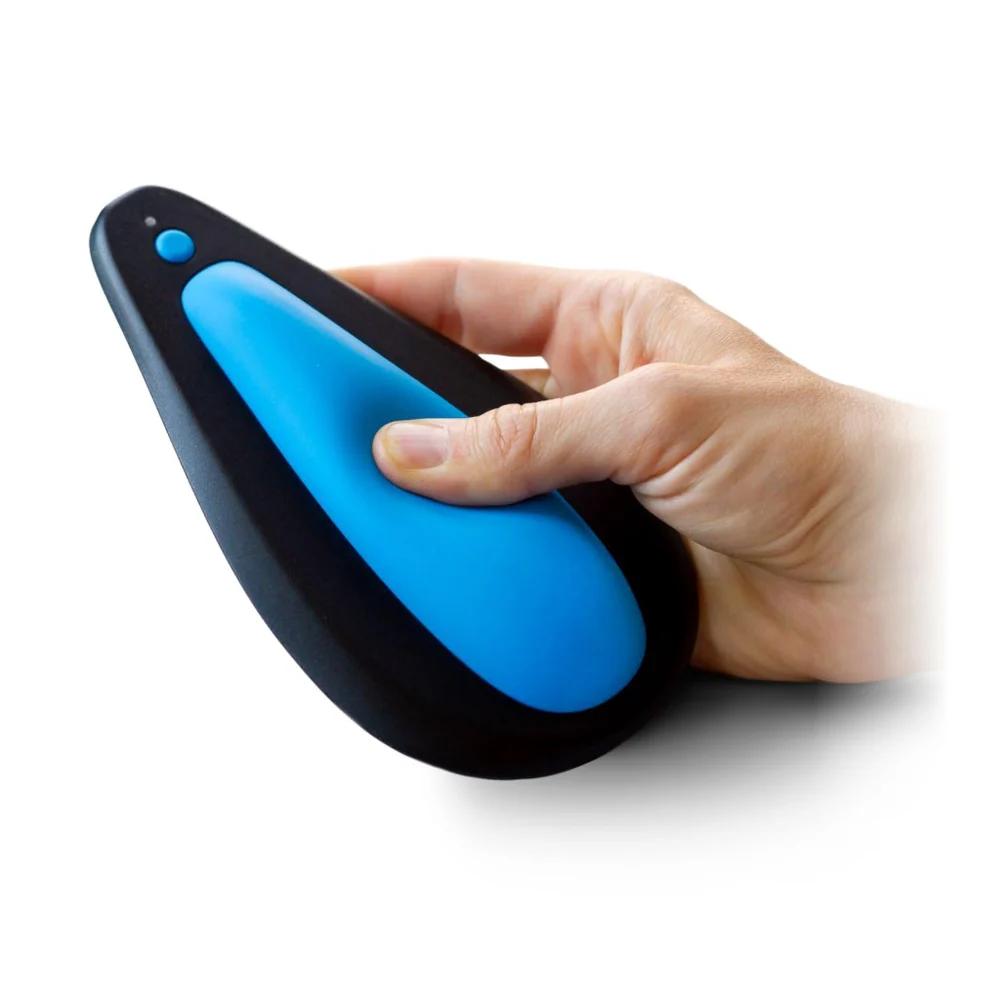
Beyond that, the bigger reason most men quit isn't a muscle problem; it's boredom. A device that gamifies sessions is easier to actually keep doing. kGoal Boost is one example, pairing real-time biofeedback with engaging guided workouts. It’s used externally, and you can use it fully clothed, making it more approachable than other biofeedback options on the market.
No biofeedback device is diagnostic or a treatment, though. Think of it as support for doing the exercise correctly and often, not a substitute or replacement for medical care.
The Bottom Line on Kegels and Male Sexual Performance
The sexual advantages of Kegels for men are real, though they're not instant and they're not universal. Consistent, correct practice genuinely improves pelvic floor strength, coordination, and control, and for many men that means real gains in erectile function and ejaculation control.
The key is doing Kegels correctly. Remember that technique and consistency matter more than intensity and rep count. A biofeedback tool like kGoal Boost for men helps ensure you're exercising the correct muscles. The gamified workouts also transform your training sessions into a fun, sustainable habit.
Make Training a Lasting Habit
kGoal Boost keeps Kegel exercises fresh with gamified, personalized workouts built for you.
References
1. Clement, P., & Giuliano, F. (2015). Anatomy and physiology of genital organs in men. Handbook of Clinical Neurology, 130, 19–37. https://pubmed.ncbi.nlm.nih.gov/26003237/
2. Li, T., He, X., Huang, W., et al. (2026). Efficacy of lifestyle interventions in treating erectile dysfunction: A systematic review and meta-analysis of randomized controlled trials. The Journal of Sexual Medicine, 23(6), qdag137. https://academic.oup.com/jsm/article/23/6/qdag137/8680197
3. Claes, H., & Baert, L. (1993). Pelvic floor exercise versus surgery in the treatment of impotence. British Journal of Urology, 71, 52–57. https://doi.org/10.1111/j.1464-410X.1993.tb15880.x
4. Dorey, G., Speakman, M., Feneley, R., Swinkels, A., Dunn, C., & Ewings, P. (2004). Randomised controlled trial of pelvic floor muscle exercises and manometric biofeedback for erectile dysfunction. British Journal of General Practice, 54(508), 819–825. https://pubmed.ncbi.nlm.nih.gov/15527607/
5. Myers, C., & Smith, M. (2019). Pelvic floor muscle training improves erectile dysfunction and premature ejaculation: A systematic review. Physiotherapy, 105(2), 235–243. https://doi.org/10.1016/j.physio.2019.01.002
6. Lyu, Y., Gong, J., He, H., Xu, H., Dong, H., & Duan, Y. (2025). Differential efficacy of pelvic floor muscle training in primary versus acquired premature ejaculation: An 8-week comparative study using non-invasive biomechanical assessment. Sexual Medicine, 13(5), qfaf081. https://doi.org/10.1093/sexmed/qfaf081
7. Prota, C., et al. (2012). Early postoperative pelvic-floor biofeedback improves erectile function in men undergoing radical prostatectomy: A prospective, randomized, controlled trial. International Journal of Impotence Research, 24, 174–178. https://doi.org/10.1038/ijir.2012.11
8. Mayo Clinic Staff. (2024, October 9). Kegel exercises for men: Understand the benefits. Mayo Clinic. https://www.mayoclinic.org/healthy-lifestyle/mens-health/in-depth/kegel-exercises-for-men/art-20045074
9. Pastore, A. L., Palleschi, G., Leto, A., Pacini, L., Iori, F., Leonardo, C., & Carbone, A. (2012). A prospective randomized study to compare pelvic floor rehabilitation and dapoxetine for treatment of lifelong premature ejaculation. International Journal of Andrology, 35(4), 528–533. https://doi.org/10.1111/j.1365-2605.2011.01243.x
10. National Institute of Diabetes and Digestive and Kidney Diseases. (2021, November). Kegel exercises. U.S. Department of Health and Human Services, National Institutes of Health. https://www.niddk.nih.gov/health-information/urologic-diseases/kegel-exercises
11. Cleveland Clinic. (2025, January 28). Kegel exercises for men: Benefits & how to do them. https://my.clevelandclinic.org/health/treatments/22211-kegel-exercises-for-men
12. Padoa, A., McLean, L., Morin, M., & Vandyken, C. (2021). "The overactive pelvic floor (OPF) and sexual dysfunction" Part 1: Pathophysiology of OPF and its impact on the sexual response. Sexual Medicine Reviews, 9(1), 64–75. https://doi.org/10.1016/j.sxmr.2020.02.002
13. Oliveira, F. A. de, Lima, L. B., da Costa, M. O., Uchôa, S. M. de M., Lenzi, J., & Gouveia, G. P. de M. (2026). Efficacy of pelvic floor muscle training in the management of premature ejaculation: A systematic review and meta-analysis of randomized controlled trials. The Journal of Sexual Medicine, 23(6), qdag131. https://doi.org/10.1093/jsxmed/qdag131
14. European Association of Urology. (2026). EAU guidelines on chronic pelvic pain: Management. https://uroweb.org/guidelines/chronic-pelvic-pain/chapter/management
15. Shoskes, D. A., Berger, R., Elmi, A., Landis, J. R., Propert, K. J., & Zeitlin, S. I. (2008). Muscle tenderness in men with chronic prostatitis/chronic pelvic pain syndrome: The Chronic Prostatitis Cohort Study. The Journal of Urology, 179(2), 556–560. https://doi.org/10.1016/j.juro.2007.09.088
16. European Association of Urology. (2026). Management of erectile dysfunction. In EAU guidelines on sexual and reproductive health. https://uroweb.org/guidelines/sexual-and-reproductive-health/chapter/management-of-erectile-dysfunction
17. Burnett, A. L., Nehra, A., Breau, R. H., et al. (2018). Erectile dysfunction: AUA guideline. The Journal of Urology, 200(3), 633–641. https://doi.org/10.1016/j.juro.2018.05.004
18. Bivalacqua, T. J., Allen, B. K., Brock, G. B., et al. (2022). The diagnosis and management of recurrent ischemic priapism, priapism in sickle cell patients, and non-ischemic priapism: An AUA/SMSNA guideline. The Journal of Urology, 208(1), 43–52. https://doi.org/10.1097/JU.0000000000002767
FAQs
Can men do Kegels?
Yes, men have the same type of pelvic floor muscles as women, just arranged around different organs, and the technique is nearly identical. Most men can start right away with no equipment, though guidance helps if you're unsure you're using the right muscles.
How long does it take to see results from Kegel exercises for men?
Most research points to 8 to 12 weeks of consistent, correct practice, with erectile function sometimes improving for three to six months [4]. Ejaculation control follows a similar timeline.
Is it a good idea to try Kegel exercises for erectile dysfunction?
Yes, particularly when pelvic floor weakness contributes to the problem. Roughly 40% of men in one trial regained normal function with consistent training [4]. Kegels won't fix every cause, though, including vascular disease or low testosterone. No change after 8 to 12 weeks means it's worth getting evaluated further.
Can you do too many Kegel exercises?
Yes. Overdoing it, especially without fully relaxing between contractions, can cause an overactive pelvic floor, worsening pelvic pain or painful ejaculation [12]. These are some of the same issues Kegels are meant to help. New pain or tightness means stop and get assessed, not push through it.
Do Kegel exercises for men need any special equipment?
No, the basic technique needs nothing but your own body and a few minutes of privacy. A biofeedback device like kGoal Boost can help confirm that you're using the right muscles, since about 30% of people get the technique wrong without guidance.
Is it normal for nothing to happen even after weeks of doing Kegels correctly?
It happens more often than you'd think. About a quarter of men in one major trial still hadn't improved after six months of correctly performed training [4]. That usually means the pelvic floor isn't the main driver, and it's worth a broader medical evaluation.