Ben Wa Balls vs. Kegel Devices: How Biofeedback Aids Pelvic Health
Ben Wa balls rely on passive weight-holding while Kegel devices can provide real-time biofeedback showing correct technique—a critical difference, since most people can't feel whether they're using the right muscles without guidance.




Published May 14, 2026

Are you dealing with leaking when you laugh or exercise, and wondering whether Ben Wa balls or one of those high-tech Kegel devices will actually fix it? Standing in front of product options, feeling completely overwhelmed about which one will work, or whether you're just wasting money on another thing that doesn't help?
This guide explains the real difference between Ben Wa balls and biofeedback Kegel devices. You'll learn when each approach makes sense, why technique confirmation matters so much, and how to choose the option that actually addresses your specific situation.
What Are Ben Wa Balls?
Let's start simple. Ben Wa balls (also called Kegel balls or vaginal weights) are small, weighted spheres—usually about marble-sized—that you insert vaginally or anally. They typically come in sets with different weights, starting lighter and getting heavier.
The idea is straightforward: pop one in, stand up or walk around, and your body will reflexively squeeze to keep it from falling out. That constant "don't let it drop" squeezing is supposed to strengthen your pelvic floor muscles through sustained contraction.
Here's how people typically use them:
- Insert the ball vaginally for women, or anally for men, with the help of a lubricant for easy insertion
- Stand, walk, or do your usual activities
- Focus on keeping the ball in place through continuous squeezing
- Take it out after 15-20 minutes
- Eventually, progress to heavier weights as holding gets easier
Why do people love this option? Simplicity. There are no apps to download, no batteries to charge, no complicated setup. Just insert and carry on with your day while supposedly strengthening everything down there and enhancing your pelvic floor.
What Are Kegel Devices (And Why Are They Different)?
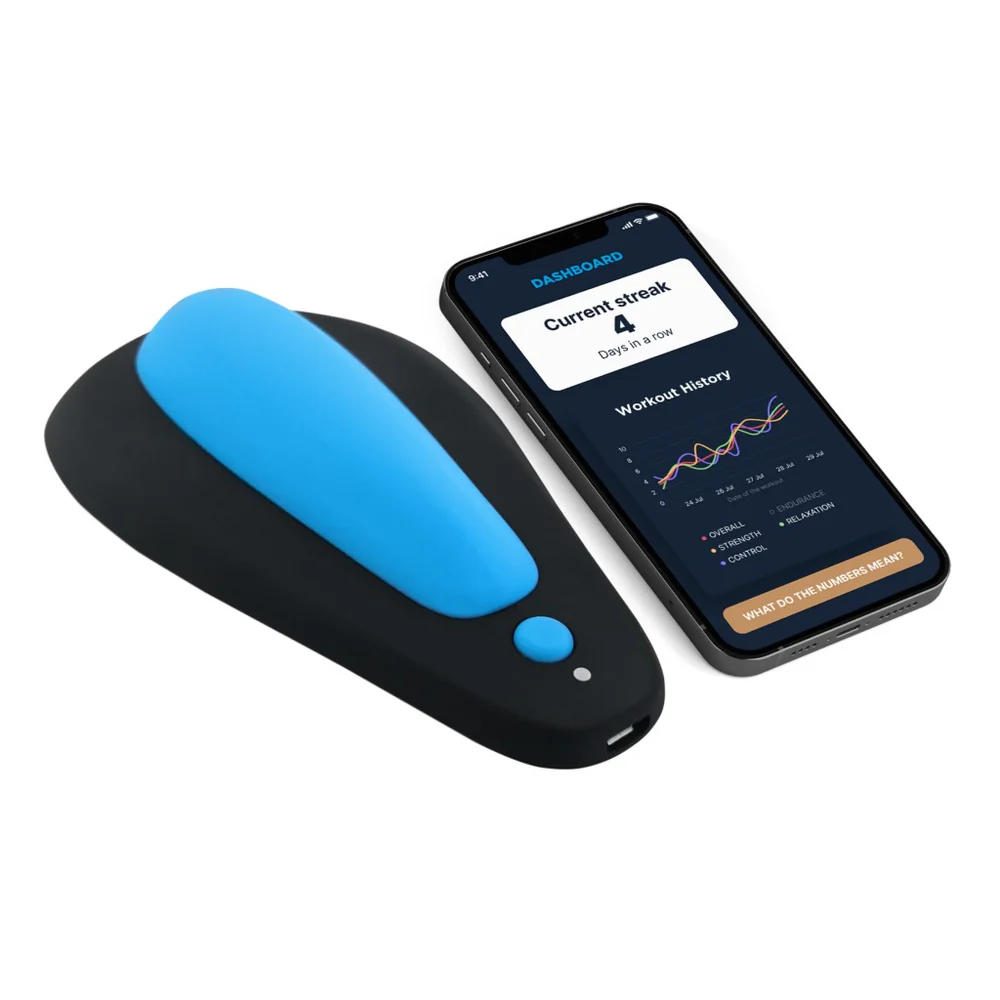
Kegel devices or pelvic floor trainers take a completely different approach. These are sensor-equipped tools that measure what your muscles are actually doing and show you in real-time whether you're doing it right.
These devices use sensors to detect pelvic floor engagement. When you try to contract, the device shows you whether you're actually lifting your pelvic floor upward (correct) or accidentally bearing down and pushing (this can actually worsen pelvic organ prolapse).
Here's how they typically work:
- Insert the sensor or sit on an external device
- Calibrate the device to your personal baseline and the device positioning
- An app guides you through specific exercises with targets
- Real-time feedback shows if you're contracting correctly
- You can track your progress over weeks and months
Modern trainers mainly give you feedback visually through your phone, although some products (like those from kGoal) additionally provide tactile biofeedback that you can feel through the device itself. It's like getting a gentle tap saying, "yes, you're doing it right" to confirm when you're doing the exercise correctly (after all, you can't see what's happening with the muscles visually).
The Difference Between Ben Wa Balls and Kegel Devices
Here's the heart of why these approaches are so different—and why it matters for your results.
With Ben Wa balls, you're guessing. Balls create a physical challenge: don't let this fall out. Your body responds by squeezing... something. But here's the problem: the ball has no way to tell you which muscles you're actually using.
Your body might successfully keep that ball in place by:
- Correctly lifting your pelvic floor upward and inward (great)
- Clenching your glutes and inner thighs (not helpful)
- Tightening your abs (doesn't train the right muscles)
- Bearing down and pushing (actually makes things worse)
- Holding your breath and creating chest pressure
The Science Behind Kegel Devices and Ben Wa Balls Working
Studies show about 21% of people drop out of vaginal weight programs, often because of discomfort, discharge, or feeling like nothing's improving [1]. That suggests that many are struggling without even knowing why.
With Kegel devices, you know what you're doing. Biofeedback trainers operate on a simple principle: try something, see whether it worked, adjust based on what you learn, and try again.
This is how we learn pretty much any physical skill, except that pelvic floor muscles are invisible, so we need technology to make them "visible."
That's exactly what biofeedback devices do: they speed up the learning process to support your pelvic health by showing you what's actually happening when you do Kegel exercises.
Support Your Pelvic Health

Why Pelvic Floor Exercise Technique Matters
Research consistently shows that 30-50% of people can't correctly perform pelvic floor exercises just from verbal instructions [3]. That's nearly half of everyone trying to fix leaking, prolapse, or postpartum pelvic floor weakness.
And this isn't a small problem—over 60% of women experience urinary incontinence symptoms at some point, and men dealing with issues after prostate surgery face similar struggles.
Imagine trying to strengthen your pelvic floor when you can't see it, feel it clearly, or get confirmation that you're doing it right. Even with good verbal instructions and anatomy lessons, you might:
- Bear down (pushing out) when you mean to lift up.
- Hold your breath during contractions.
- Clench your glutes or abs way too hard.
- Not be able to generate any voluntary contraction at all.
What Happens When You Practice Without Feedback
Using Ben Wa balls without any confirmation means you might be practicing incorrect patterns for weeks or months. Your body learns whatever successfully keeps that ball in place, even if that pattern involves pushing, clenching your butt, or holding your breath.
None of those things helps your symptoms, and some actively make them worse.
Now, it might feel like progress because you're successfully holding heavier and heavier weights. But if you're holding them with the wrong muscles, your actual symptoms, like incontinence or back pain, don't improve at all.
What Each Approach Actually Trains (And Doesn't Train)
Let's look into what you're actually getting with each option.
What Ben Wa Balls Give You
- You get good at continuous squeezing to keep something in.
- You can feel "something happening" down there.
- You can wear them while doing other things.
- Timing and Coordination: Can you squeeze quickly right before a cough or sneeze? Can you engage your pelvic floor while jumping or running? Balls don't train this at all.
- Isolation: Are you actually using your pelvic floor, or are you compensating with glutes and abs? Balls can't tell you.
- Relaxation: Can you fully relax between contractions? Do you need to learn how to release tight muscles? Balls only make you squeeze harder.
Medical experts at Nebraska Medicine explain that healthy pelvic floor function needs strength, endurance, coordination, and flexibility, not just continuous squeezing power [4].
Or if you have painful sex, your muscles might be too tight and need to learn to relax before they need strengthening; using balls would make this worse.
What Kegel Devices Train
- Correct Activation: You can see the difference between properly lifting versus accidentally bearing down.
- Progressive Strength: Programs increase in difficulty systematically as you improve.
- Functional Coordination: You practice timing contractions with breathing and movement.
- Relaxation: Programs coach you on fully releasing (especially important in devices like kGoal Boost that include "down training").

When Each Approach Actually Makes Sense
Let's talk about when you might choose one over the other.
Ben Wa Balls might work if:
- A pelvic floor physical therapist has already assessed you and confirmed that you can contract correctly.
- You're comfortable with vaginal insertion and don't experience irritation or discharge.
- You want a low-tech, app-free option for maintenance after you've already learned proper technique through formal training.
- You're confident in your form and just want passive resistance during daily activities.
But, research comparing pelvic floor exercises to cones found that structured exercises worked better for treating stress incontinence [6]. So even when balls are appropriate, they might not be the most effective choice.
Kegel devices make more sense for you if:
- You're learning pelvic floor control for the first time.
- You're experiencing leaking, urgency, or other symptoms despite trying exercises on your own.
- Taking care of your pelvic health during pregnancy or postpartum recovery, when you need to rebuild coordination after childbirth.
- Dealing with prolapse symptoms where bearing down could make things worse.
- Experiencing pelvic pain or tightness that might need pelvic floor relaxation training, not just strengthening.
- You want to track progress objectively and get adherence support.
What Could Go Wrong With Ben Wa Balls
The main concerns are materials that are hard to clean properly (which can harbor bacteria), hygiene issues like discomfort and discharge that make people quit, and technique risks—if you're bearing down to keep them in place, you could actually be worsening prolapse.
There's also no built-in pacing, so you might overwork muscles without realizing it. And balls don't screen for situations where strengthening is completely wrong for you, like active infections, severe prolapse, or overly tight muscles that need relaxation instead.
What Could Go Wrong With Kegel Devices
A clinical trial reported no serious adverse events with biofeedback devices in studies that tracked safety [7].
Minor issues (occasional discomfort or discharge) were similar to balls, but modern trainers include helpful features like:
Prompts to fully relax.
Hygiene reminders.
Screening questions about contraindications.
Progressive pacing that prevents overdoing it.
External options that avoid insertion entirely.
How kGoal Keeps Pelvic Floor Training Safe
kGoal Classic and kGoal IntimFlex give you feedback in two ways at once—visually through your phone and through gentle vibration. You try a contraction, get immediate confirmation whether it worked, adjust, and try again. That's how you build a reliable technique without reinforcing wrong patterns.
The devices can calibrate specifically to your body, preventing frustration from targets that are impossibly hard or uselessly easy. Programs include both strengthening and relaxation guidance, because healthy pelvic floor function needs both.
You get progress tracking showing actual improvements—no more wondering if you're getting stronger. kGoal Boost extends these benefits to external training without insertion.
If you're dealing with pain, dryness, discomfort, or simply prefer non-invasive options, Boost for men and Boost for women give you the same biofeedback guidance plus down training programs for overly tight pelvic floors—something completely absent from Ben Wa balls and rare among consumer trainers.
Choosing What's Right for You
For most people dealing with leaking, postpartum recovery, prolapse, or just wanting to strengthen preventively, biofeedback training gives the best shot at real improvement. Ben Wa balls work only if the technique is already confirmed correct. Biofeedback devices eliminate the guesswork by showing exactly when you're doing it right.
Choose what matches your situation: if you've already been assessed by a physical therapist with confirmed good form, balls might work for simple maintenance. If learning for the first time, recovering from childbirth, or dealing with symptoms despite prior attempts, biofeedback provides the structure and confirmation that actually gets you results.
Make the Right Choice
With kGoal showing you in real-time whether you're doing it right, perform exercises that actually work.
References
1. Perna, S., Salman, M., Gasparri, C., Cavioni, A., Faliva, M. A., Mansueto, F., Naso, M., Patelli, Z., Peroni, G., Tartara, A., Riva, A., Petrangolini, G., & Rondanelli, M. (2022). Two, Six, and Twelve-Month dropout rate and predictor factors after a multidisciplinary residential program for obesity treatment. a prospective cohort study. Frontiers in Nutrition, 9, 851802. https://doi.org/10.3389/fnut.2022.851802
2. Szumilewicz, A., Hopkins, W. G., Dornowski, M., & Piernicka, M. (2019). Exercise professionals improve their poor skills in contracting Pelvic-Floor muscles: a randomized controlled trial. Research Quarterly for Exercise and Sport, 90(4), 641–650. https://doi.org/10.1080/02701367.2019.1642993
3. Dar, G., & Saban, T. S. (2022). The Perception of Pelvic Floor Muscle Function amongst Exercising Women Who Are Repeatedly Instructed to Contract Their Pelvic Floor Muscles. Healthcare, 10(9), 1768. https://doi.org/10.3390/healthcare10091768
4. Pelvic floor, Kegels and how physical therapy can help. (2023, June 6). Nebraska Medicine Omaha, NE. https://www.nebraskamed.com/womens-health/pelvic-floor-kegels-and-how-physical-therapy-can-help
5. Dumoulin, C., Cacciari, L. P., & Hay-Smith, E. J. C. (2018). Pelvic floor muscle training versus no treatment, or inactive control treatments, for urinary incontinence in women. Cochrane Database of Systematic Reviews, 2018(10). https://doi.org/10.1002/14651858.cd005654.pub4
6. Cammu, H., & Van Nylen, M. (1998). Pelvic floor exercises versus vaginal weight cones in genuine stress incontinence. European Journal of Obstetrics & Gynecology and Reproductive Biology, 77(1), 89–93. https://doi.org/10.1016/s0301-2115(97)00237-6
7. Hagen, S., Bugge, C., Dean, S. G., Elders, A., Hay-Smith, J., Kilonzo, M., McClurg, D., Abdel-Fattah, M., Agur, W., Andreis, F., Booth, J., Dimitrova, M., Gillespie, N., Glazener, C., Grant, A., Guerrero, K. L., Henderson, L., Kovandzic, M., McDonald, A., . . . Williams, L. R. (2020). Basic versus biofeedback-mediated intensive pelvic floor muscle training for women with urinary incontinence: the OPAL RCT. Health Technology Assessment, 24(70), 1–144. https://doi.org/10.3310/hta24700
FAQs
Are Ben Wa balls better than Kegel exercises?
Actually, research shows the opposite—structured Kegel exercises worked better than cones for stress incontinence. Ben Wa balls only help if your technique is already correct. Since 30-50% of people can't perform contractions correctly without guidance, balls risk reinforcing wrong patterns. Biofeedback devices combine structured exercises with real-time confirmation that you're doing it right.
How long should I wear Ben Wa balls?
Clinical studies using weights typically recommend 15-20 minute sessions daily. But here's the catch—if you're doing it wrong, longer just means more practice of an incorrect pattern. If you choose balls, start with 10-15 minutes and stop immediately if you feel discomfort, pain, or increased urgency. Those are signs you might be bearing down or overworking the muscles.
Can Ben Wa balls make things worse?
Yes, unfortunately. If you're keeping them in by bearing down (pushing) instead of lifting up, you're increasing pressure that can worsen prolapse. People with overly tight pelvic floors can also experience worse pain, urgency, or tension from continuous squeezing without relaxation breaks. This is exactly why getting your technique checked before starting any strengthening program is so important.
What's the difference between Ben Wa balls and Kegel balls?
These terms usually mean the same thing—weighted spheres for pelvic floor exercise. "Ben Wa" is the traditional name; "Kegel balls" emphasizes their exercise purpose. Both work through passive weight-holding without any feedback about whether your technique is correct.
Are biofeedback Kegel devices worth the extra cost?
If you're learning pelvic floor control, recovering from childbirth, or dealing with symptoms despite trying exercises on your own, biofeedback devices give you technique confirmation that passive weights simply can't provide. Research shows biofeedback significantly increases how confident and satisfied people feel, even though outcomes might be similar to well-taught exercises. The value is in eliminating all that guesswork.